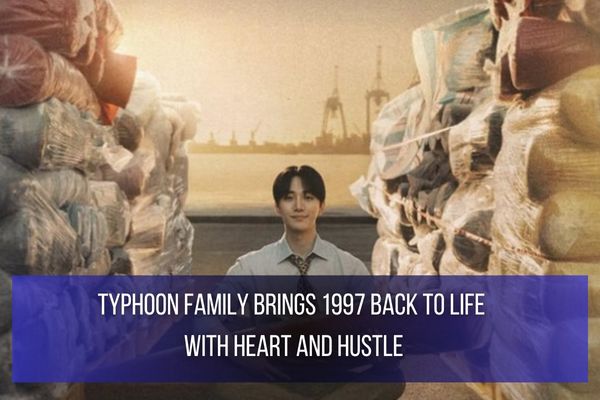
A Weekend Drama That Hits Too Close to Home
Hey — if you’ve been scrolling through your streaming list hoping to find drama that doesn’t feel like just another flick, Typhoon Family might be your new obsession. It’s one of the freshest Kdramas this October, and honestly, it sneaks up on you.
Set during the dramatic financial crash of 1997, this series isn’t just about money and business. It’s about people — people doing everything they can not to lose their dignity when the world’s unraveling. It’s raw. It’s emotional. And yes, it’s very bingeable.
Let me walk you through why Typhoon Family is exactly the kind of drama you’ll want on your weekend playlist.
Typhoon Family A Story Born From Crisis
When people hear “1997 IMF crisis,” most think economics, banks collapsing, debt everywhere. But what about families? Jobs lost? Dreams crushed overnight? That’s what Typhoon Family shows us — the human side of catastrophes.
The protagonist, Kang Tae Poong (played by Lee Jun Ho), comes from privilege and stability. His family owns a company, lives well, and expects the name to carry him. But then the crisis hits. Suddenly, his comforts vanish. The company teeters on collapse, resources are stripped down, and what was once certain becomes fragile.
It’s in that chaos that Tae Poong meets Oh Mi Seon (played by Kim Min Ha), a disciplined, rational accountant. She’s everything he isn’t: cautious, methodical, grounded. Yet the two of them find themselves thrown together by chance — and by fate. Their chemistry doesn’t begin in fireworks. It begins in struggle.
Watching them navigate this brutal 1997 backdrop — with no shortcuts, no safety nets — is a refreshing take in a sea of fantasy and melodrama. This is a K-drama that says: life doesn’t pause just because you want it to.
Youth, Loss, and Growing Up Too Fast
I sometimes think the most compelling stories are those that force characters to become adults too soon. Typhoon Family leans into that.
Tae Poong acts on instinct. He takes risks. He makes decisions that seem foolish when you see the bigger picture. But you feel for him, because those choices come from a place of desperation and love. He’s not always right, but he’s always trying.
Mi Seon, in contrast, uses logic as a shield. She thinks through everything. Plans ahead. Rejects rash emotion. Yet crisis tears down those walls. Together, they learn from each other — she tempers his recklessness, he teaches her how to fight when life demands it.
You’ll catch moments where they stare off at nothing, just trying to make sense of what they’ve lost. You’ll see small gestures — offering a cup of water, waiting up late, taking a risk they didn’t have to take. Those are the moments that linger.
A Detailed Recreation of 1997 Korea in Typhoon Family
One thing that absolutely blew me away about Typhoon Family is the care with which the production team reconstructed that era. The clothes, the hairstyles, the streets, even the equipment — telex machines, retro phones, old storefront signage — everything feels lived-in.
I read that the director, Lee Na Jung, personally interviewed people who lived through the ’97 crisis. They visited old business districts, neighborhoods that still held 90s architecture, and dug into archived photos to get things just right.
Scenes in Apgujeong, Euljiro, and old apartment complexes don’t just look nostalgic — they feel nostalgic. There’s a coolness in the air you can almost sense through the screen. It’s the kind of drama that makes you pause, rewind, then pause again, just to soak it in.
Relevance That Hits Today
Even though it’s set almost 30 years ago, Typhoon Family doesn’t feel distant or out of touch. The struggles it portrays — job insecurity, debt, the pressure to uphold family legacy — those are things people still face today.
Watching characters desperately try to salvage businesses or support aging parents hits on an emotional wavelength many viewers resonate with in 2025. Maybe we haven’t had an IMF crash, but economic uncertainty, emotional trauma, and the fear of being forgotten — those are evergreen.
The drama doesn’t just dwell in nostalgia. It holds up a mirror: to ambition, to sacrifice, to the cost of survival.
Typhoon Family Behind the Scenes You’ll Love
- The cast: Lee Junho as Tae Poong and Kim Min Ha as Mi Seon bring authenticity and subtlety to their roles. Their chemistry is quiet, real, not forced.
- Supporting characters add layers. Yes, the antagonists will make you shake your head, but each side has stakes.
- Direction & writing: The balance between personal stories and the larger national crisis is handled well. Scenes of economic collapse and scenes of small humanity sit side by side without one overshadowing the other.
- Soundtrack & visuals: Soft piano in tragic moments, hopeful strings in breakthrough ones. Cinematography leans on wide cityscapes and close-ups of expressions — all to accentuate tension and intimacy.
When and Where to Watch Typhoon Family
If you’re itching to start, here’s the schedule:
- Netflix carries Typhoon Family — perfect for bingeing across weekends.
- Episodes drop Saturdays and Sundays at 19:10 WIB.
- There are 16 episodes total, each about 60 minutes long.
- The premiere kicked off on October 11, 2025.
Here’s a quick guide:
- Episode 1: Oct 11
- Episode 2: Oct 12
- Episodes 3 & 4 follow the next weekend
- And so on, up to Episode 16: Nov 30
Mark your calendars. This is the kind of show where missing one episode feels like losing a beat.
Why You Shouldn’t Miss Typhoon Family
- It’s a powerful mix of heartbreak and hope.
- The period detail is addictively strong — you’re pulled into 1997 like a time traveler.
- It’s grounded in real emotion and real stakes, not fantasy.
- The performances are nuanced and unforgettable.
If your current watchlist is feeling a little too fluffy, Typhoon Family is the dose of depth it needs.